

Inequality in sports journalism, and how women like Lesley Visser Have Worked to fix it
- Next Woman Up Blog
- Feb 15, 2021
- 5 min read
Updated: Mar 9, 2021

“I’ve gotten tweets that the only reason I have a job is because of my looks; I’ve also gotten plenty more tweets that, you know, I’m an unattractive reporter who shouldn’t be on television”- Tina Cervasio, Sports Anchor.
Hello and welcome to the Next Woman Up Blog! I am so excited to start off our first post but first I would like to provide an introduction to what will be discussed in this blog. The name “Next Woman Up” reflects the fact that women are highly capable in the area of sports media, and are not nearly appreciated enough.
While not an avid sports watcher, in the past couple of years, I have developed an interest in basketball. I love to watch NBA games in my free time, but never catch myself watching WNBA games, which drove me to wonder why, and further examine why women’s sports are hardly shown on television, and also how women are very misrepresented in all aspects of sports media.
This year, when the Lakers won the NBA finals, I came across a post on my Instagram feed about the wage gap between two very talented players, Lebron James and Sue Bird, who are almost exactly equal in their accomplishments and titles, yet through the infographic, it is clear that they do not get paid anywhere close to each other. Lebron James was making 37.44 million dollars, whereas Sue Bird was making a mere 215,000 dollars. This led me to further research the wage gap between men and women in professional sports.
Because of this misrepresentation and inequality, myself, a woman, contributed to this problem. I was ignorant and uninformed, and I hope to educate others through this blog about the gender inequalities in the world of sports. Watch Women Blog’s goal is to highlight important female figures in the area of sports media, while also examining and explaining the injustices that unfortunately are very present in this field. I would like to enlighten others who perhaps hadn’t thought of this issue before, like myself. Now, we will dive into the first aspect of this issue that I would like to address.
For the first blog post, I would like to talk about the world of sports journalism, and women’s roles and representation in this area. In March of 2017, 62.3 percent of news reports were produced by men, whereas 37.7 percent were produced by women. It is no secret that there are more male reporters and anchors then female ones, and while this statistic may not be overly shocking to the average person, the experiences and inequality these women face is the real problem.
Again, while bored during the Covid-19 pandemic I found myself watching one of the first sports to return to television, which was basketball. The NBA set up a bubble in Orlando Florida, where players were able to stay for months in a Disney resort and play basketball safely while abiding by Covid protocols. While making notes for this blog post, I could not recall if the WNBA had a bubble set up during this time, and when I googled it, there was a stark comparison between the WNBA and the NBA bubble. In fact, WNBA players complained of mouse traps, bed bugs, and worms in their hotel in Bradenton, Florida. It was clear that not near the same amount of thought was put into the WNBA bubble. But I’m drifting away from the topic of female sports journalists. When I began to watch games in the NBA bubble, I also came across vlogs that some of the NBA players had posted. Intrigued, I watched many player's vlogs, such as Javale McGee, who was playing on the Lakers at the time, and Matisse Thybulle, rookie on the Philidelphia 76ers. Alongside the player’s vlogs, vlogs from female sports journalist for Bleacher Report, Taylor Rooks, appeared in my suggested videos. Of course, I watched her recount of the bubble experience and interactions with the players. I was surprised as to how well she was able to connect with the players and get meaningful responses out of them. But when I looked at that video’s comments, expecting praise, all the comments were men talking about her looks. And this is one of the main issues that female sports journalists experience on the daily.
Women journalists face what is called a double bind, which means that they feel pressure to look presentable for the camera, but also are often told that they just have their job just because of their looks. Kim Jones, sports reporter for the NFL Network, said that she’s gotten tweets that say that the only reason she has a job is because of her looks and, on the contrary, has also gotten tweets saying that she is an unattractive reporter who shouldn’t be on television. Another reporter, Tina Cervasio said that she still gets tweets saying go back in the kitchen. She says that people are worried about color of hair and how a woman looks. She also adds that if she was as fat and bald as [some male sportscasters], she would not have her job.
Aside from the unnecessary commentary female reporters receive about their looks, female sports journalists also often face much more criticism than men when they make the same mistakes. Maybe it's a simple joke, like being called a "dumb blonde". Or maybe it's blamed on the fact that women just "don't know sports". Whatever it is, it is wrong, and frankly sexist. When men make the same mistakes, fans treat them reasonably.
And these issues are not only present in America or globally, it is also present right here in Canada. A CBC reporter explains one of her experiences as a sports reporter in Toronto, when she says that "I was outside the ACC with my cameraman we were getting ready to go live. We probably had only a few minutes before the live, and there was a group of men behind us and they started catcalling and in particular started to get very personal. He said hey you in the whatever color coat I was wearing, you know, I want to **** you in the ***. You've never had it so good. He went on for a long time and at first I just sort of brushed it off and made a joke of it with my cameraman. I let it go but it just kept going and going and going to the point where it felt like a violation, it felt like sexual harassment."
So many female sports reporters and journalists have similar stories to these women, which is simply horrible, and shows why the industry needs to change.
On a brighter note, there has been some change made, thanks to women who have served as positive role models, and while they also faced many of their own struggles, continue to show how a woman can be successful in this industry, and how they won't quit fighting for equality. One of these women is Lesley Visser.
Lesley Visser is a role model for many sportswriters, especially female ones. She was voted the number one female sportswriter of all time in a poll taken by the American Sportscasters Association. She was also elected into the National Sportscasters and Sportswriters Association’s Hall of Fame in 2015.
From the age of 10, Lesley wanted to be a sportswriter. She loved watching sports on television in her spare time. However, there was one problem. This job simply didn't exist for women. There were no female sportswriters that Lesley saw when she turned on the televison. However, this did not discourage her. Her family was accepting of her dreams, and as Lesley puts it, “My parents didn’t say girls can’t do that, and my mother told me, ‘Sometimes you have to cross when it says “don’t walk.”’
Later, in 2009, Lesley Visser became the first woman to be an analyst for an NFL game on TV.
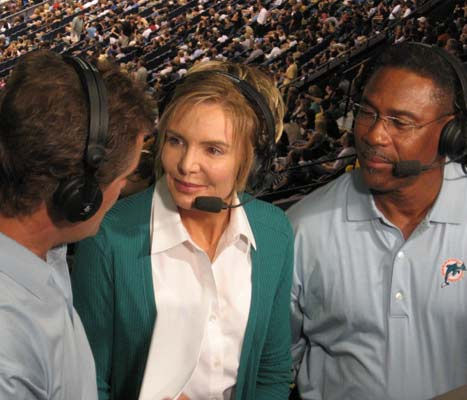
Needless to say, Lesley Visser broke many stereotypes for women in sports, and also serves as a role model for many accomplished female sports reporters, writers, and journalists today.


Comments